Finding a fault on camera is only half the job. To fix it efficiently, you also need to know exactly where that fault sits underground — how far along the pipe and how deep. This is where sonde locating comes in, and it is one of the most valuable parts of a modern inspection. This lesson explains how it works and why it matters.
What is a sonde?
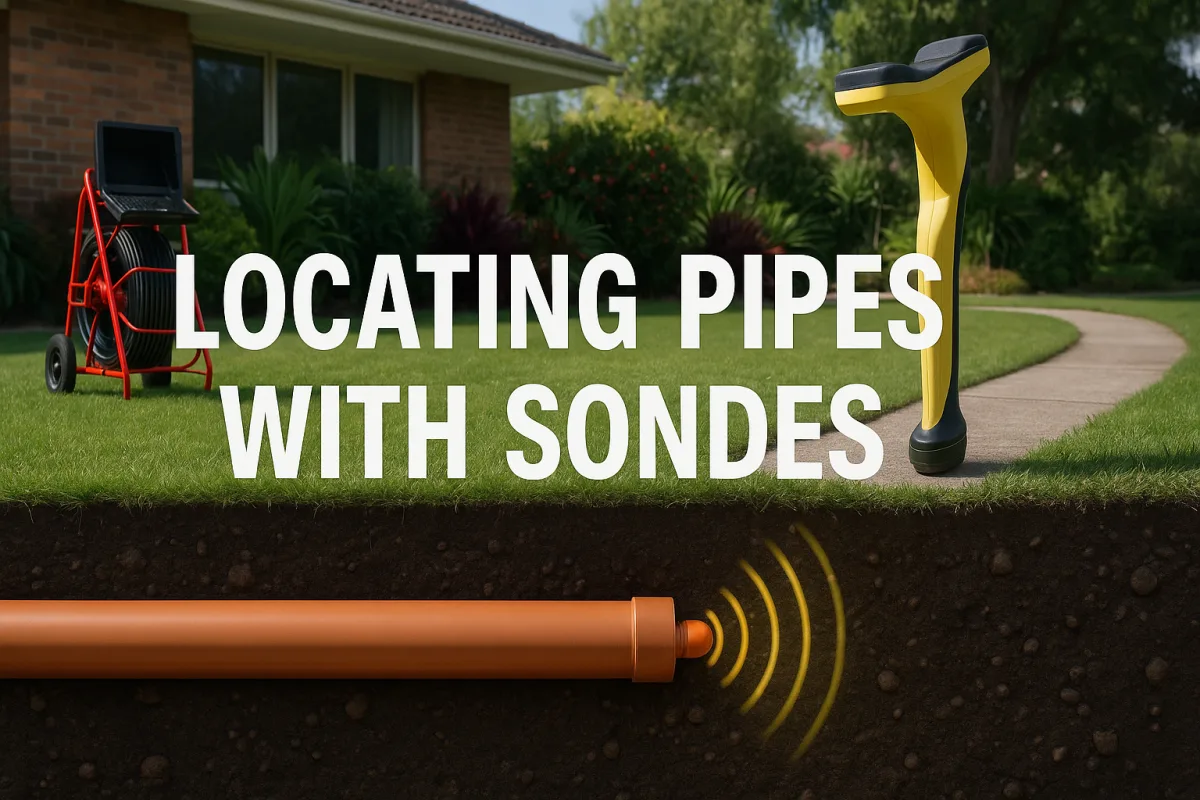
A sonde is a small transmitter built into or fitted near the camera head. It emits a signal at a set frequency. Because the sonde travels with the camera, wherever the camera stops — say, at a cracked joint — the sonde is broadcasting from that exact spot beneath the ground.
How the locator finds it
Above ground, a technician uses a handheld locator tuned to the sonde's frequency. By sweeping the area, they can detect where the signal is strongest, which sits directly over the sonde. The process usually runs like this:
- The camera is driven to the fault and stopped.
- The sonde is switched on (or is always transmitting).
- The technician sweeps the surface with the locator to find the peak signal.
- They mark the ground directly above the fault.
- The locator also estimates the depth of the sonde below the surface.
The result is a precise mark on the lawn, driveway or garden showing exactly where to dig — and how far down — if a repair is needed.
Why accurate location matters
Precise positioning transforms a repair. Instead of opening a long trench hoping to find the fault, a plumber can excavate a small, targeted hole right over it. In Brisbane properties where drains run under paving, established gardens or concrete, that difference can mean far less disruption and lower reinstatement costs. It also helps avoid accidentally striking other services nearby.
Knowing precisely where a fault is can be the difference between lifting one paver and digging up half a driveway.
Depth as well as position
Locating is not only about the spot on the surface — depth matters just as much. Knowing a pipe is, for example, a metre down versus two metres down changes how a dig is planned and how much work it involves. The locator's depth estimate gives the plumber a head start on that planning.
Things that affect accuracy
Sonde locating is reliable but not magic. A few factors can affect it:
- Depth — very deep pipes give a weaker signal and a less precise depth estimate.
- Interference — nearby metal, other utilities or electrical sources can distort readings.
- Soil and ground conditions — these can subtly influence the signal.
- Operator skill — as with the camera, an experienced technician gets the best results.
A good operator accounts for these and confirms readings from more than one direction before marking the ground.
Putting it together
Sonde locating is what links the picture on the screen to a real point on your property. Combined with the camera footage and the distance counter, it turns a diagnosis into an actionable plan. To see how this fits into the wider process, read the step-by-step inspection process.
If you need a fault located before planning a repair or landscaping, a licensed plumber can help — get in touch via the contact page or explore drainage services.