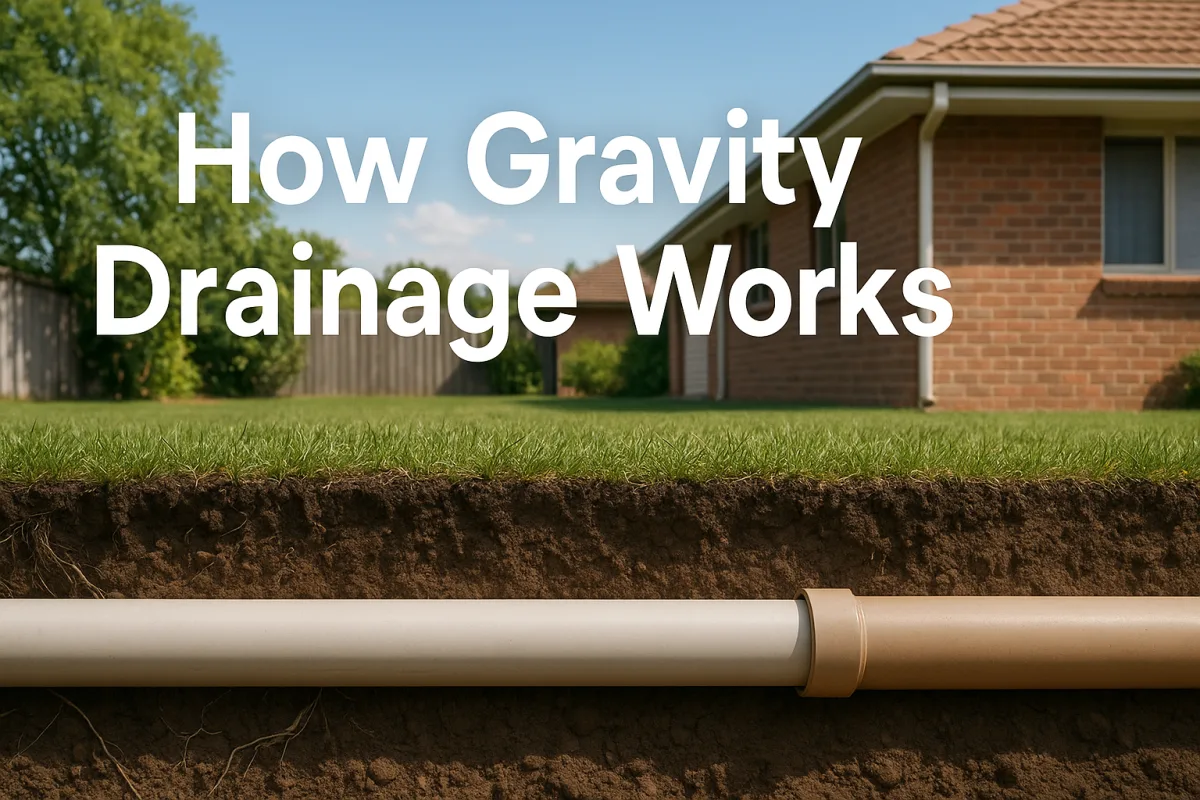
The vast majority of drains work without any pumps, motors or pressure. They rely on one dependable force: gravity. By laying pipes at a gentle downhill slope, a drainage system lets water — and the solids it carries — flow steadily towards the main and out to the network. It is quiet, efficient and, when designed well, remarkably reliable.
The principle of fall
The downhill slope of a drain is called its fall or gradient, usually expressed as a ratio like 1 in 60, meaning the pipe drops one unit for every sixty it travels horizontally. Fall is the engine of gravity drainage: it converts height into flow. Too little and the water barely moves; too much and it can behave in unexpected ways. Fall is important enough that we devote a whole lesson to it in understanding drainage gradients.
Self-cleansing velocity
Good gravity drainage does more than move water — it carries solids along with it. This depends on achieving a self-cleansing velocity: the flow must be fast enough to keep solids suspended and moving, so they do not settle and build up. The right fall produces a flow that is brisk enough to scour the pipe clean each time it is used.
A well-laid drain cleans itself a little every time you use it. The flow keeps solids moving so nothing has a chance to settle and build up.
What goes wrong when the slope is off
Getting the fall wrong causes distinct problems:
- Too little fall: water moves sluggishly, solids settle out, and the pipe gradually silts up and blocks.
- Too much fall: water can race ahead and leave solids stranded, and in some layouts it can even siphon trap seals.
- A sag or "belly": if a pipe dips below its intended line — often from ground movement or poor bedding — water pools in the low spot, trapping debris and causing recurring blockages.
Brisbane's reactive clay soils make sags a real risk, as ground that swells and shrinks with moisture can push a once-perfect pipe out of alignment over the years.
How the whole system uses gravity
Gravity drainage is a chain of downhill steps. Each fixture drains into a trap, the trap into a branch, the branch into the main, and the main to the boundary — every stage lower than the last. For this to work, the whole route must be planned so it consistently heads downhill without unintended rises. This is why drainage layout is carefully designed rather than improvised, and why adding fixtures far from the main can be tricky: the fall has to be found somewhere.
When gravity needs help
Sometimes gravity alone cannot do the job — for example, a basement bathroom below the level of the sewer, or a low-lying part of a block that sits under the discharge point. In these cases a pump lifts the wastewater or stormwater up to where gravity can take over again. Common solutions include:
- Sewage pump stations for fixtures below the sewer level.
- Sump pumps for stormwater or groundwater in low areas.
- Charged stormwater systems that use pressure to move roof water uphill to a discharge point.
Pumped systems introduce moving parts and power requirements, so they need maintenance that a pure gravity system does not. Where gravity can be used, it almost always should be.
The takeaway
Gravity drainage is elegant precisely because it is simple: no power, no pressure, just a well-chosen slope doing steady work. When it fails, the cause is usually a disturbed fall — a sag, a blockage or a poorly laid section — rather than the principle itself. Understanding this helps you see why a recurring blockage in one spot often points to a pipe that has lost its proper fall.
If you have a persistent blockage or suspect a sagging drain, a licensed plumber can assess the fall, often with a camera. To discuss your situation, reach out through the contact page or explore the available services.