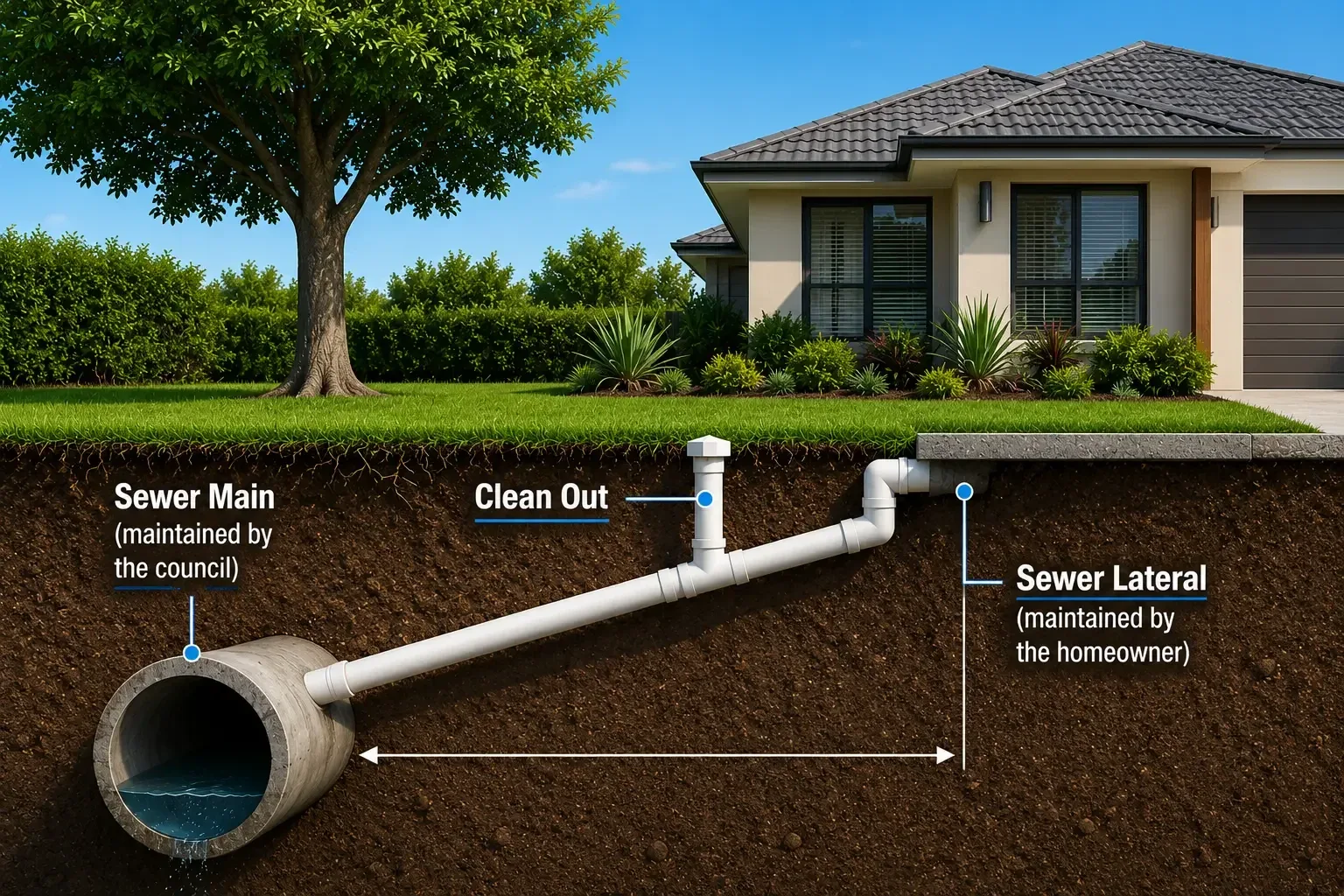
The words "sewer main" get used loosely, but they describe something specific and important. A sewer main is the large, shared underground pipe that collects wastewater from many homes and businesses and carries it toward a treatment plant. It is the trunk of the network, while the pipes on your property are the branches that feed into it.
Knowing what a sewer main is — and where it sits in relation to your own pipes — helps you understand who is responsible for what, why some blockages are your problem and others are not, and how the whole system keeps a city's wastewater moving.
How a sewer main works
A sewer main is usually a large-diameter pipe buried beneath streets, easements or the rear of properties. Most of the network relies on gravity: pipes are laid on a gentle, continuous fall so that wastewater flows steadily downhill without pumping. Where the land is flat or low-lying, pumping stations lift the flow so it can continue on its way.
Along the route, access chambers (often called manholes or maintenance holes) let the utility inspect, clean and maintain the line. The main gathers flows from hundreds or thousands of individual property connections and consolidates them into ever-larger pipes heading toward treatment.
Your house drain versus the main
The pipes that carry wastewater from your toilets, sinks, showers and laundry are your house drain (sometimes called the sanitary drain or property drain). These are relatively small pipes owned and maintained by you, the property owner. They run across your land until they reach a connection point, where they join the sewer main.
The distinction matters because it usually determines who fixes a problem and who pays for it. As a general rule:
- Your side — the drains on your property, up to the connection point, are your responsibility.
- The utility's side — the sewer main itself and the shared network are maintained by the water utility.
The exact rules vary by location and situation, so treat this as a general principle rather than legal advice. The who owns which drain lesson explores the responsibility question further.
The connection point
The place where your house drain meets the sewer main is a defining boundary. It is often marked by an inspection opening or a junction fitting. Everything upstream of that point, on your land, is generally yours to maintain; everything downstream, in the shared main, is generally the utility's.
Because the connection point sets the boundary of responsibility, knowing roughly where it sits on your property is genuinely useful when a blockage strikes.
Why main blockages behave differently
A blockage in your own house drain typically affects only your home — one toilet backs up, or a gully overflows. A blockage or surcharge in the sewer main is a bigger event, because the main serves many properties at once. Signs that a problem may be in the shared network rather than your pipes include:
- Several neighbouring properties experiencing backups at the same time
- Wastewater surcharging from a low gully or overflow relief point during heavy rain
- Gurgling or slow drainage across multiple fixtures with no obvious cause on your side
If you suspect the main is the culprit, the water utility is the right first call, because they are responsible for that infrastructure. If the problem is clearly on your side, a licensed plumber can locate and clear it.
Keeping the main healthy
You cannot maintain the sewer main yourself, but what you do at home protects it. Avoid flushing wet wipes, fats and oils, or other items that cause blockages downstream. Managing tree roots on your property helps too, since roots are a leading cause of damage in older sewer networks. For more on protecting your own lines, see drainage do's and don'ts for homeowners.
If you are unsure whether a problem lies with your drains or the sewer main, a licensed plumber can help you locate the fault and point you to the right party. You can reach DrainSpy Brisbane through the contact page to talk it through.