Most causes of blocked drains announce themselves fairly quickly — a grease clog, a wad of wipes, a mat of hair. Mineral scale is different. It is the slow, silent cause, building up so gradually over years that a pipe can lose much of its capacity before anyone notices. Understanding scale helps explain why an old pipe can block even when nothing obvious has gone wrong.
What scale actually is
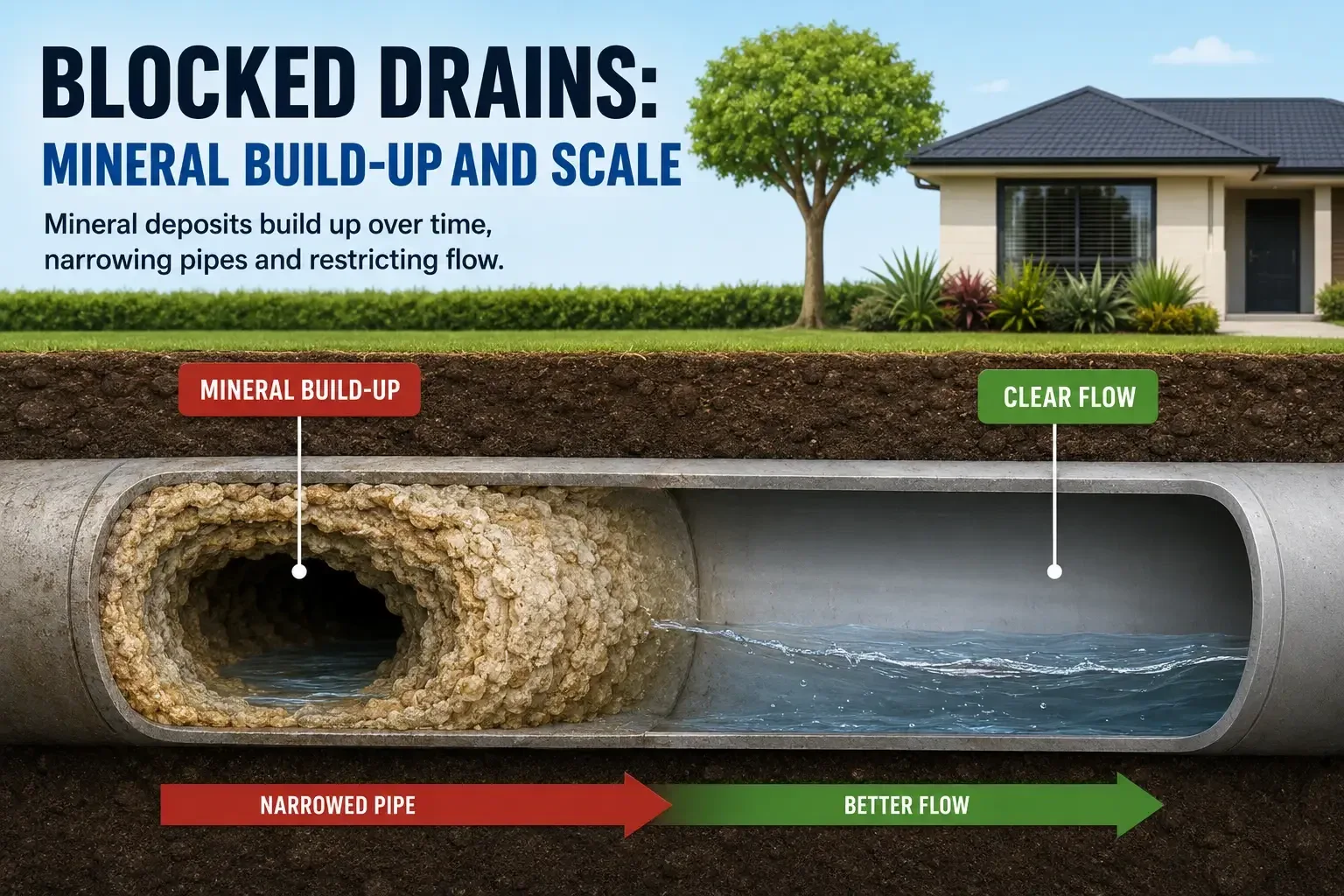
Scale is a hard, crusty deposit made mostly of dissolved minerals — commonly calcium and magnesium compounds — that come out of the water and stick to the inside of pipes. The minerals are naturally present in the water supply. When water sits, evaporates slightly, or changes temperature, some of those minerals separate out and settle on the pipe wall. Layer by layer, over months and years, they build into a rough, rocky crust.
You have probably seen the same process on a shower head or inside a kettle. The white, chalky deposit there is scale. The same thing happens, out of sight, inside pipes.
Why it develops so slowly
The gradual nature of scale is what makes it sneaky. A single day adds an amount too small to measure. But drainage and water pipes are in constant use, and the deposit never stops growing. Over a decade or more, the internal diameter of a pipe can be significantly reduced. Because the change is so slow, a household adapts without realising — water that was once fast is now merely normal, then slightly slow, then a problem.
Scale also creates a rough surface. A smooth new pipe lets water and debris slide through. A scaled pipe grabs at everything, so hair, grease and other material snag more easily. In this way scale makes every other cause of blockage worse.
Where scale matters most
Scale can form anywhere water flows, but it tends to matter most in:
- Older metal pipes, where scale combines with corrosion to roughen and narrow the bore.
- Hot water lines and fixtures, because heat encourages minerals to separate from the water.
- Shower heads, tap aerators and appliance inlets, where you notice reduced flow first.
- Long-standing drainage lines that have been in service for many years.
Scale rarely blocks a pipe by itself overnight. Its real damage is roughening and narrowing the line over years, so every other kind of debris finds it easier to lodge and build up.
Signs of scale build-up
Scale is hard to see directly, but there are clues:
- A gradual, long-term drop in water flow or drainage speed with no single obvious cause.
- White, chalky deposits on shower heads, taps and around fixtures.
- Reduced pressure at hot water outlets in particular.
- Fixtures and appliances that need descaling more and more often.
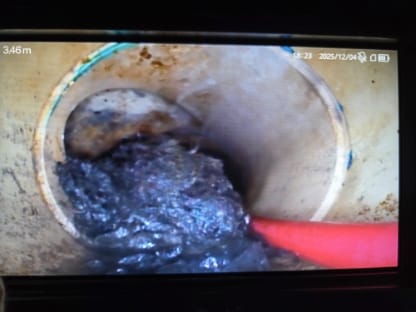
Because these signs overlap with other problems, a CCTV inspection is the reliable way to confirm scale inside a drainage line, and to see how much of the pipe's capacity remains.
Managing and clearing scale
For fixtures, regular descaling of shower heads and aerators — soaking them in a suitable descaling solution — keeps flow strong. Inside drainage pipes, a heavy scale layer is physical and hard, so it usually needs mechanical removal or high-pressure water jetting to scour it back to a clean bore, work best done by a professional. In areas with harder water, some households use water treatment to reduce the mineral load reaching their pipes in the first place.
If your drains or water flow have slowly declined over the years and no single blockage seems to blame, scale may be the underlying cause. A professional can confirm it and advise on the best way forward — reach out via the contact page. For a broader view of pipe faults, see the collapsed and cracked pipes lesson.